Creating clear messages across sales, marketing and Pr.
An introduction to messaging, that brings together brand, leadership and thought-leadership, to work…
Businesses will typically include a SWOT (Strengths, Weaknesses, Opportunities, Threats) in a business plan. It's largely focussed on the internal; what a business can do to leverage what is in its power to grow.
A PEST analysis on the other hand looks at external forces that might have an impact on a business future.
It’s important for PR and external communications, because the impact a powerful person, business, or trend (outside the business) can have is what interests journalists.
Here I'll consider how a PEST analysis can help early stage firms develop a thought-leadership narrative around their business.
Using a PEST Analysis to identify relevant topics
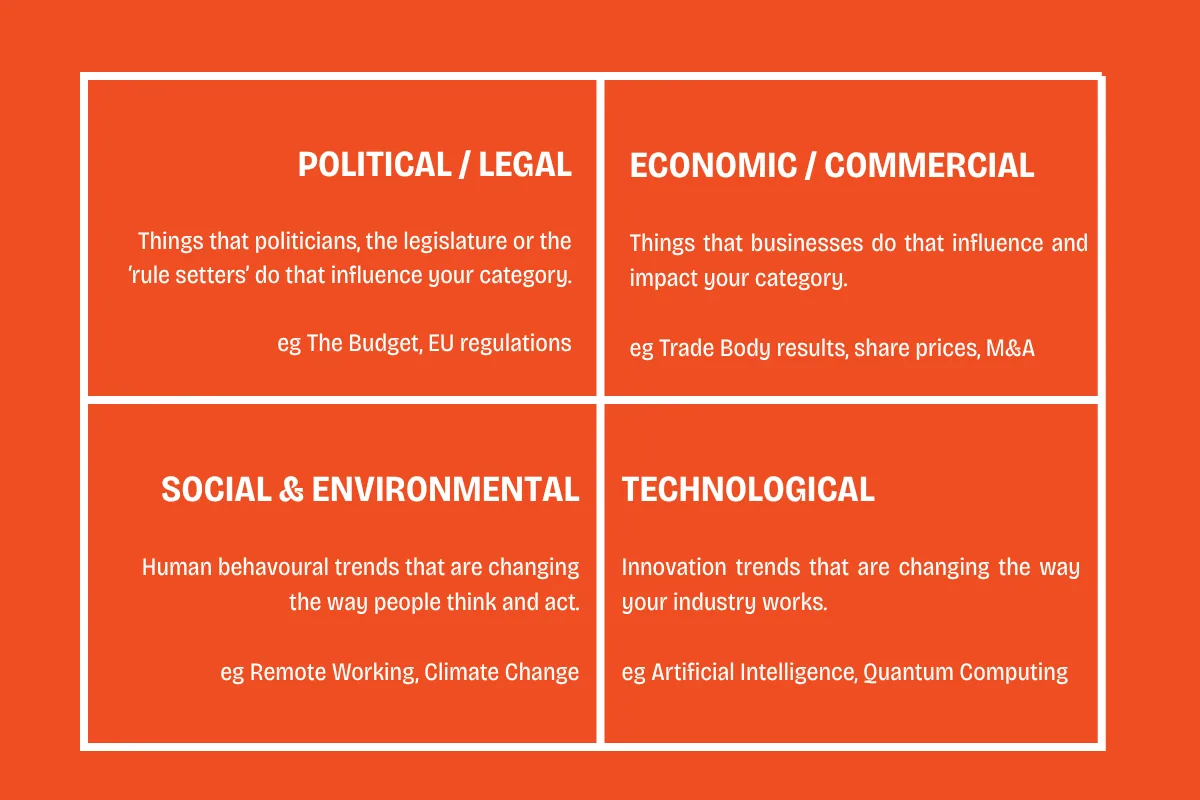
PEST is an acronym for Political, Economic, Societal, and Technical.
Political and Economic events drive the news agenda. News is a report of something impactful that a powerful or famous person has done.
Journalists with ‘correspondent’ or ‘reporter’ or ‘news’ in their title are primarily interested in this, and they live in the now. The now, or the news agenda, is what drives most media outlets.
Societal and Technical trends drive the features agenda; developments in human behaviour, and developments in technology.
These are trends, in that they set context for news events.
Journalists with ‘features’, ‘editor’,’or ‘comment’ in their titles typically write about these themes, commissioning staffers or freelancer expert journalists in those areas to produce a longer-form opinion-led features. These may be opinion articles ‘bylined’ to a notable individual or features.
The first step is to identify events and topics that your business might be able to take a qualified point of view on. Start by asking these questions;
Political
Economic
Sociological
Technological
Discussing the above questions, and researching the answers, will help identify what, in your sector, is reported on and talked about.
Aim to summarise each trend in a hashtag, and see how often that keyword comes up in google searches, is mentioned in the media titles that matter to your industry (or your customers) or how it is being referenced on social media.
The next step is to establish if anyone in the business has any experience, or knowledge of these trends, and get their detailed take on the questions above. Then we ask two questions that will establish whether a thought-leading position can be taken on each.
Question 1 / Can we offer agency?
By this, I mean do you want anyone to change anything, in a way that will be impactful to our constituency or audience.
Typically this might be a call to action; to a group of impacted citizens, the leadership of a large business, or a trade body, regulator, politician or other influencer in a position of power.
Question 2 / Do we have any first-party evidence to support our proposed course of action?
This may be owned-data, a personal experience, or a company case study. This gives the spokesperson authority, and proof that backs up the course of action they are suggesting.
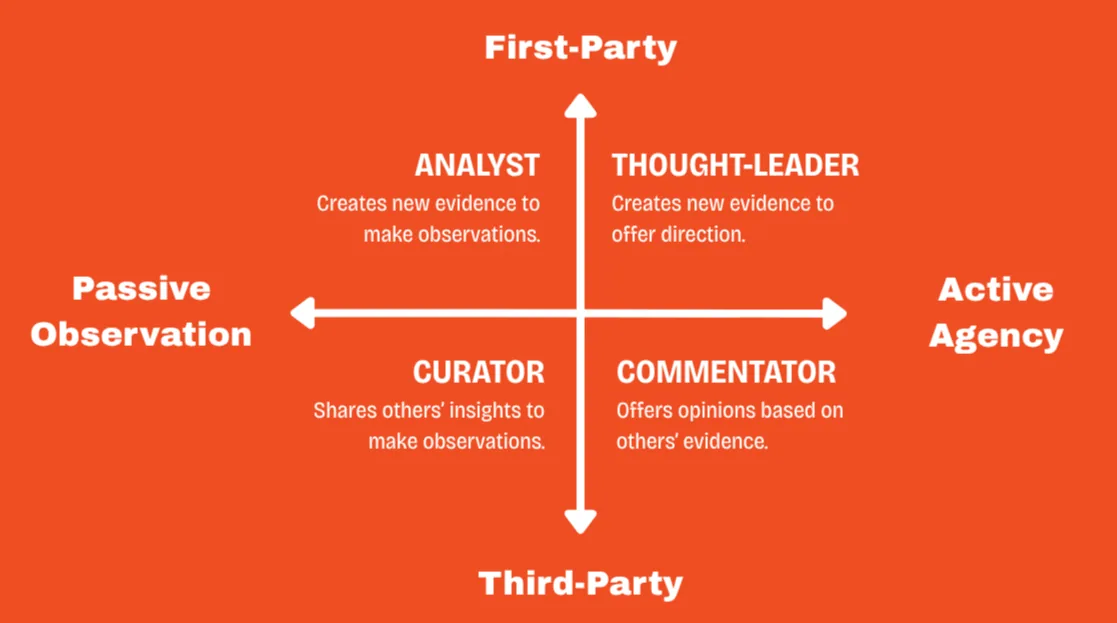
The matrix below shows this.
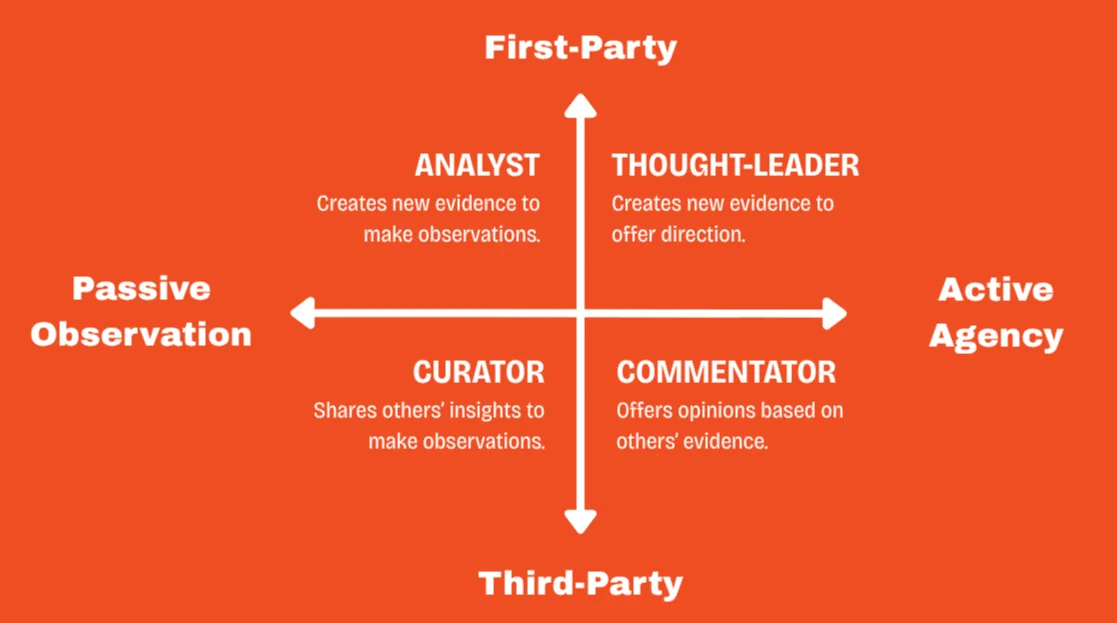
Defining thought-leaders: using first-party experiences or data, to offer direction.
The topics/ hashtags can be placed on this grid in order to assess which will be the strongest topics to talk about.
Here I define thought leadership as an area where a business can provide agency (i.e. leadership) and new evidence (i.e thoughts) through the lived expertise of its people.
Often, a smaller business won't have a natural thought leader.
And even if they do, that person may be in a leadership position so finds it difficult to find the time.
But as this matrix shows, campaigning-style thought-leadership is not the only thing a business can talk about.
Even if your business is only curating and observing the views of others, there may be value in that by association.
Journalists crave diversity in spokespeople.
Sometimes, this is more important experience or influence.
Pitches for opinion articles and speaking platforms from females, non-whites, people who are neuro-diverse or different in some way, are more likely to be accepted by editors.
People who stand out with flair and quirks, also get noticed.
Even if that's just a trivial quirk like wearing a distinctive people of clothing.
And even if there is no agency being offered, or evidence, proof or anecdote - someone who is well-informed and researched, clear and coherent will have a good chance of attracting media attention even if they are simply curating.
Step One is to make sure that someone in the business is tuned in to the outside world.
In practical terms, this means investing in media monitoring - tracking the companies, individuals and topics that people in your industry are talking about - if only using a free service like Google Alerts.
Sign up for newsletters from the relevant trade publications and review them periodically.
I often advise clients to create a bespoke inbox to receive alerts and newsletters, so they don’t clog up any one person’s inbox, they can be forwarded to others and remain useful even when that person leaves. Sometimes you’ll get a hint of something that may happen in the future; this can be captured in an events calendar.
A PR agency can also do this and most-likely will want to in order to advise you better and spot opportunities, but I generally advise clients to do at least monitoring in house.
Step Two is to curate, flag relevant leads to an internal spokesperson.
Create an internal directory of people who could be potential spokespeople; the business leader, sector experts, or diverse spokespeople.
Consider their existing profile - are they already well-connected? Do they naturally post content and express views? Do they want to grow their own profile and influence?
When a hot topic is discussed in a prominent or important media title, share this content with these internal spokespeople to see if they have a point of view. What does this development mean for your audience? Can we say anything that is useful, or different?
Step three is to produce content, this could be a short post/ a few lines to curate an observation, or a longer-form opinion article to unpack an idea or theory or a more-directive piece of thought-leadership advocating change.
It may be that the topic is so important to the business that it produces a longer white paper, potentially including new interviews with clients and prospects or new primary data.
All of this activity gets businesses in the habit and rhythm of looking outside and producing content - the backbone of a wider content marketing strategy.
Keep reading
An introduction to messaging, that brings together brand, leadership and thought-leadership, to work…

A guide to case studies: why they are hard to create, why the process of creating them is important,…
Using my Six A copywriting method, you can ensure the content will meet the standard for PR (and…
A short, no-obligation call. We will talk about where you are trying to grow, which audiences matter, and whether the method fits.