Why I taught a machine how to not write a press release.
First I asked AI to give me a a ‘Robot News Agent’. Wasn’t happy with the initial results. So then I…
Consultant, agency, freelancer or fractional comms director? What’s the difference, and what PR capability does your business need?
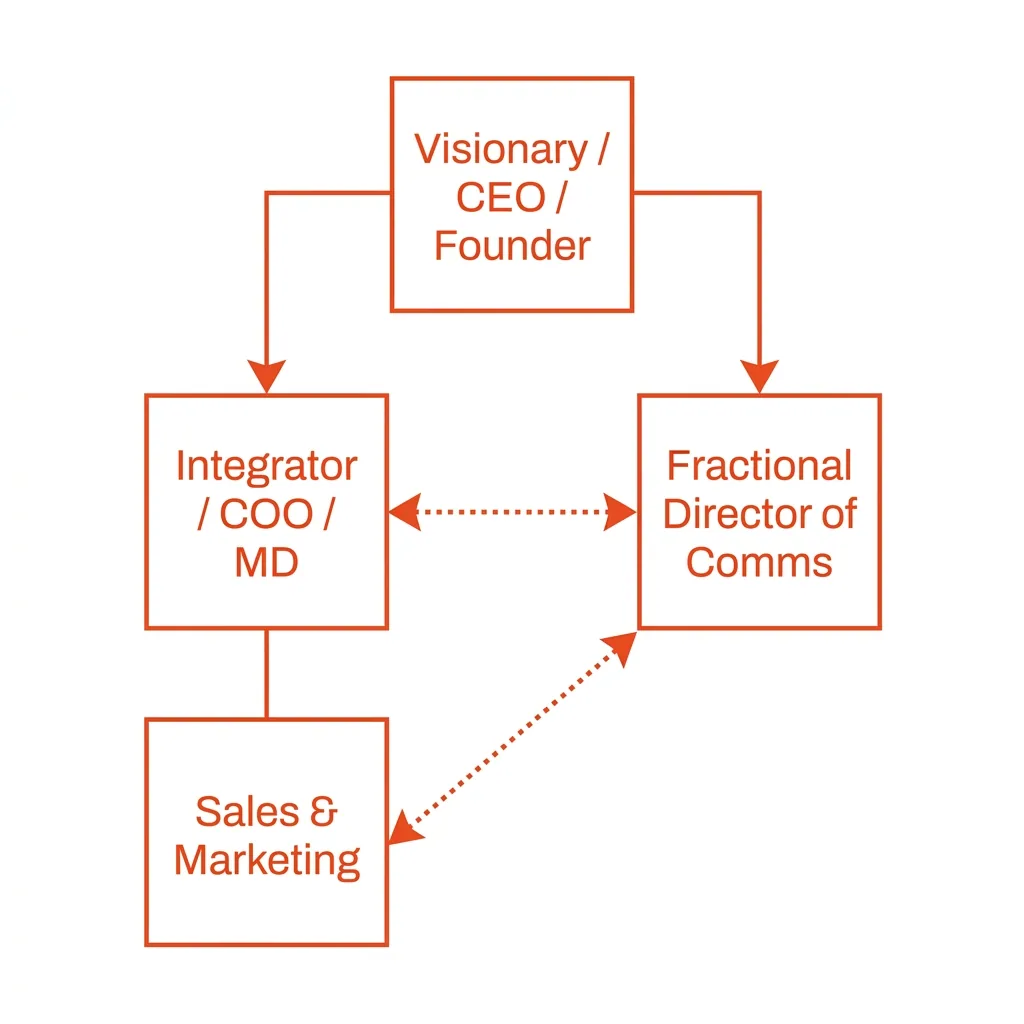
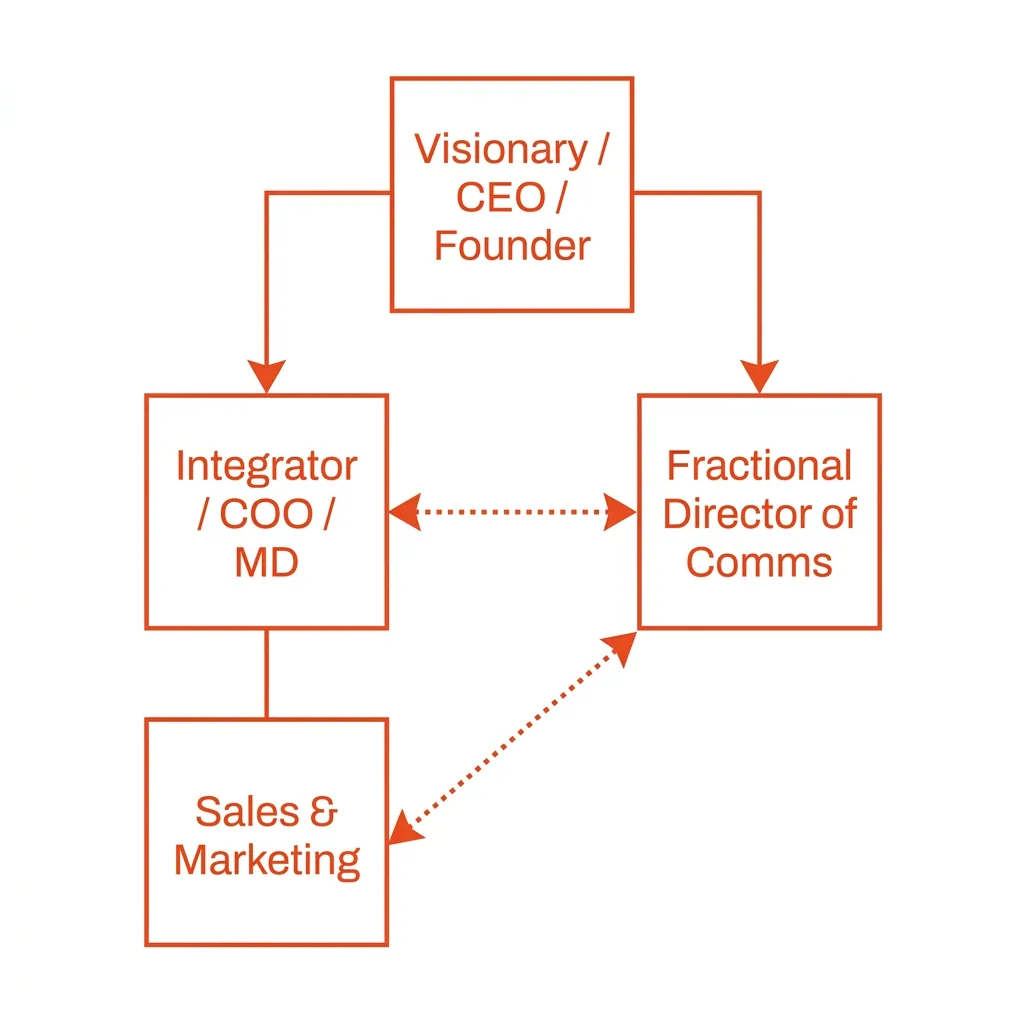
A fractional director of communications will typically report to a CEO as part of the leadership team, working to support the sales & marketing function. This example is for an organisation that will have a more junior tactically-led marketing team (rather than a senior CMO).
If you're a business leader who knows PR could help you grow, but you're not sure what kind of help to buy, you've probably run into three options: engage a consultant, appoint an agency, or bring on a freelancer.
So you could be forgiven for asking - “so what’s a fractional director of communications?”
The ‘fractional’ moniker, in particular is a newer term - and has grown in usage in recent years particularly as people have left full-time salaried roles in favour of portfolio careers.
It’s more commonly used for traditional department leaders who run teams in ‘core’ business areas that have direct lines of accountability to the business leader and carry significant budgets, such as people, finance, product or marketing.
This isn’t always the case in PR, where it often falls with the remit of marketing and can be seen as a luxury, which is why, as a discipline it may not get the credit it deserves or scrutiny it requires.
Consultant, freelancer, fractional… people may use the terms interchangeably and not always correctly (I myself have been guilty of this).
But the differences matter, because each offers something slightly different and it’s important for a business leader looking at PR resources to be clear-headed about what each means.
A consultant gives you a brain for hire. You explain the problem, they go away, and they come back with a strategy, a deck, a set of recommendations. It's often genuinely good thinking.
The catch is what happens next. The consultant hands you the plan and leaves you to execute it. If you don't have a comms team, or your team is already flat out, that plan may well end up in a drawer. You've paid for the map but you're still driving the car yourself.
Consultancy works brilliantly when you have the capability to act on the advice. It works badly when the advice is the gap you were trying to fill.
An agency gives you a team. On paper that's more firepower: more hands, more brains, more disciplines, more capacity.
Often business leaders with experience of hiring agencies complain that they get sold to by the senior people, but typically end up being serviced by junior people.
Unless you have a senior-level person managing this relationship you’ll end up managing it: chasing, approving, and re-explaining context the agency was never close enough to absorb.
There's also a structural tension. Most agencies operate on an hourly-billing basis, where the commercial interest is in billing more hours, whilst yours is in solving the problem as efficiently as possible. The agency may be tempted to step back if they feel they have over-serviced, or create valueless busywork if they’ve not delivered the expected outcomes.
In my experience most agencies operate in good faith, but as the commercial interest is misaligned, this can put strain on the trust and goodwill in the relationship.
This is not to say agencies are not worth hiring. Many are brilliant for scale, reach, specialist sector and big set-piece campaigns. But if what you need is senior judgement woven into how the business runs, a modest retainer with a junior account team isn't going to deliver enough value to justify the investment.
Using the inverse of my earlier heading might read a bit harshly, but the point here is that freelance publicists can be brilliant at executing on projects in their area of specialism and may have first-class media relationships - but are not necessarily hired to get under the skin of your business.
Freelance publicists’ main area of focus is typically the media. They will know what works, what doesn’t, who to contact. They are often highly-specialist and are often more experienced and affordable than the equivalent experience you’d buy from an agency.
In my experience, the best publicists end up operating in fractional-like roles as they often have deep sector knowledge and are hired on longer-term retainers and become part of the team rather than a hired-gun to deliver a specific project.
They may however require experienced management - for example as an experienced specialist extension of an agency team - or under a CMO with deep PR experience.
A fractional director offers elements of all the above.
You get a senior person with previous board-level experience, who will doing the actual work, but it’s only a fraction of their time you need. They're not a supplier you manage from arm's length. They're part of your leadership team, just part-time.
That changes everything about how the work feels:
A full-time hire would typically cost in the region of £150,000 p/a upwards when salary, tax, perks, pension are taken into account.
This is why companies don’t tend to hire senior PR people until they hit a tipping point when they a) become large enough to afford it and b) move from a small brand hustling for any attention they can get to becoming an enterprise with a reputation to manage.
This means most businesses fail to benefit from the wider value a senior communications person can bring.
As a Fractional Communications Director I typically work between the business leader and the marketing team, using PR to drive the business’ growth.
Marketing is rightly focused on leads and pipeline; my job is the wider reputation, the narrative, and all the audiences (i.e the "publics") you may want to engage. This is direct customers, yes, but also investors, partners, future hires and maybe the industry at large.
My Full Funnel PR model is a system, not a strapline. It sets out what a fully-developed mature communications function looks like, considers where your business is, what its objectives are, what resources it has at its disposal and will prioritise the things that will deliver the best growth with what’s available.
The work is structured, repeatable, and tied to outcomes rather than activity:
The result is strategic, measurable, and senior. You're not buying a campaign or a clever deck. You're plugging a board-level communications function into your business for a fraction of the cost of a full-time hire, and a fraction of the hassle of running an agency.
As a rough rule of thumb:
If it sounds like the gap you've been trying to fill, let's have a conversation.
Keep reading

First I asked AI to give me a a ‘Robot News Agent’. Wasn’t happy with the initial results. So then I…

I’m a new member of Pimlico Group, a consultant collective. I’ll advise marketers on how to manage…

PR is hard for Series A founders. Start unprepared, and you’ll waste time and money. Take too long…
A short, no-obligation call. We will talk about where you are trying to grow, which audiences matter, and whether the method fits.